|
4 December 2005 |
|
|
http://www.floridatoday.com/apps/pbcs.dll/article?... |
|
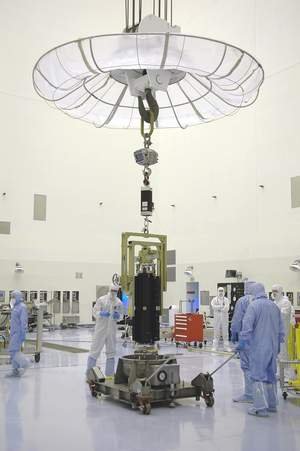
But after about $60 million worth of testing during a half-century, the plutonium-fueled generators have been blown up, burned in rocket fuel fires, blasted with shrapnel and smashed with high-speed rocket sleds. "We design them for accidents. We don't count on things going right," said Alice Caponiti, a nuclear safety manager with the U.S. Department of Energy. Known as a Radioisotope Thermoelectric Generator, the nuclear battery converts heat from the decay of plutonium into electricity to heat and power spacecraft systems. The fuel is not the plutonium used in nuclear weapons. It cannot explode or cause the type of radiation sickness that followed the Three Mile Island and Chernobyl accidents. It is only dangerous to humans if reduced to a fine dust and ingested or inhaled. The generator is a multilayer containment system designed to prevent release of the radioactive isotope in accidents. Here's how it works: First, the fuel comes in hard ceramic pellets that do not dissolve in water and that resist vaporization when exposed to extreme heat. They are designed to break into large chunks that cannot be inhaled. About the size and shape of marshmallows, each pellet is encased in high-strength iridium, which has a melting point of more than 4,000 degrees. Tests show the pellets tend to stretch out or flatten, rather than rip open, in explosions or collisions. Next, the pellets are placed in pairs in tough graphite shells designed to limit damage from shrapnel in an explosion and resist the heat of an accidental atmospheric re-entry. Eighteen aeroshells are loaded into a super-strength container that forms the outer hull of the generator. In an accidental re-entry, the aeroshells are designed to separate to reduce the speed at which they would crash on land or at sea, thereby minimizing the chance of a plutonium release. The safety tests are extreme. In certain scenarios, small amounts of plutonium could be released during an inadvertent plunge through the atmosphere. Tests show that small amounts could be released if a fully intact rocket failed early in flight, crashing into a hard surface -- such as steel or concrete -- rather than water or sand. Government studies show the probability of an accident is low and only the area immediately surrounding the launch pad likely would be affected. The chances of a substantial release beyond the spaceport is extremely remote. "We all live in this area," said Ray Lugo, a Merritt Island resident and a NASA deputy launch services manager at KSC. "So we're not going to sign up to this launch if we're not totally confident." Contact Halvorson at 639-0576 or thalvorson@flatoday.net See also: other articles on New Horizons
|
|
|
|